

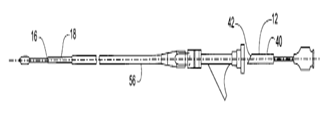
A long-running patent dispute between Teleflex and Medtronic recently ended by settlement after a remand that was unusual even for seasoned patent litigators. Teleflex accused Medtronic’s Telescope guide-extension catheter of infringing a family of catheter patents. Medtronic prevailed in district court when the court held a repeated claim phrase, “substantially rigid portion/segment,” indefinite — in other words, the phrase was too unclear to tell a person of ordinary skill in the art what the patent claims covered. But the Federal Circuit vacated that judgment, held that the district court had taken too rigid a view of the claims, and sent the case back for further proceedings. What happened next made the case especially noteworthy: the original district judge recused himself because he was “at a loss” on how to proceed consistently with the appellate ruling, a second reassigned judge also recused, and the parties later settled.
The uncertainty came from two groups of claims across the related patents. In one group (for example, dependent claims 13 and 18 of U.S. Pat. No. 8,048,032), the side opening was described as part of the substantially rigid portion. In another group (for example, independent claim 25 of U.S. Pat. No. RE45,776), the side opening was described as a separate segment located distal to the substantially rigid portion. Teleflex mapped both groups to the same accused Medtronic device, but with the endpoint of the substantially rigid portion moving depending on the claim. The district court treated that as a problem with what the claims meant, not merely with which claims might be infringed: if the same term could include the side opening in some claims but exclude it in others, the court was not convinced a skilled artisan could tell where the claimed portion began and ended.
The Federal Circuit disagreed. It held that patent claims may divide the same disclosed device in different ways, so long as they give a skilled artisan reasonable certainty about the scope of the invention. The same term could still be construed consistently as a functional term – a portion rigid enough to allow the device to advance through the guide catheter – without assigning the exact same physical endpoint in every claim. That did not decide infringement. It meant the accused product must still be compared to each properly construed claim, claim by claim; the possibility that one product might satisfy one claim but not another is not, by itself, a reason to invalidate the claims as indefinite.
The surprising turn was remand. The Federal Circuit told the district court to proceed claim by claim, but the original judge recused himself, explaining that he could not reconcile that instruction with his view of the record; a reassigned judge also recused, apparently under the general standard for cases where impartiality might reasonably be questioned, and the parties settled before any final infringement ruling. The lesson is both reassuring and cautionary: different claim combinations can draw different boundaries around the same structure without automatically becoming indefinite, but flexible drafting can become expensive if the patent and litigation theory do not clearly explain why those differences make sense. For lawyers and businesses outside the patent bar, the broader point is familiar: precision matters, but so does the ability to explain, in plain terms, why the words fit together.